
A marble slab looks one way in a showroom and another in a finished room. In a real space it meets daylight at a low angle, gets walked on, and sits next to timber, brass, and fabric. Two homes can use the same stone and end up with very different results.
That gap is where the best marble supplier India has to offer proves its value. Supplying stone is the easy part. The harder part is helping a client read a slab for what it will do in a particular space: which marble to select, how its veining will travel across a wall or floor, and which finish suits the light.
This article is written for homeowners, architects and interior designers planning a marble-led space. It ends with a pointer to the RRM Marbles imported marble collection for anyone ready to look at slabs in person.
The Slab Is Only the Starting Point
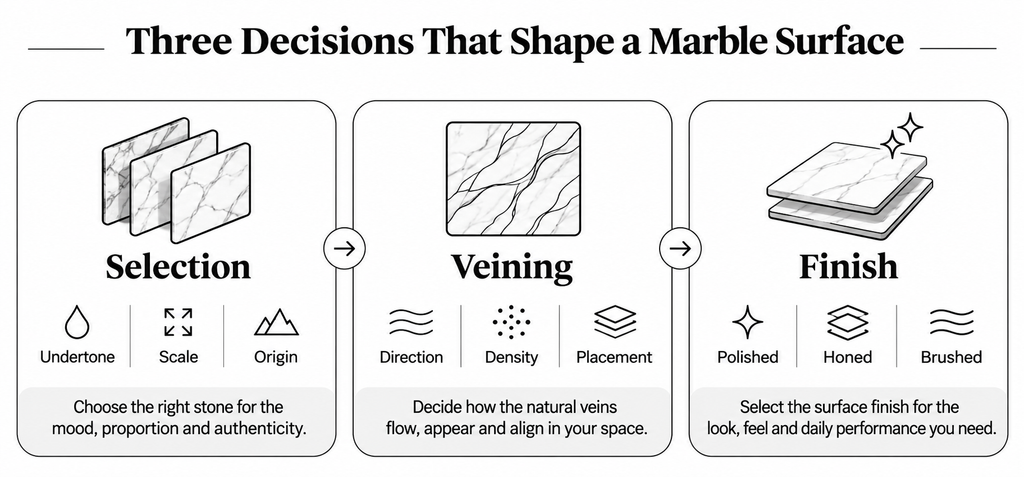
A luxury interior is judged on the surface people see, and that surface comes from three decisions made in sequence. The marble sets the base colour and character. The veining sets the movement. The finish sets how that movement catches light.
Most projects get the first decision right and rush the other two. A designer approves a stone from a small sample, then finds on site that the veins run across the room in a direction nobody planned, or that the finish turns a calm hall into a glare. Marble is natural, so no two slabs match, and those later decisions cannot wait for the fabrication stage. A premium marble company in India raises them during selection, while the full slabs are still in front of you.
The three also depend on each other. A strong vein asks for a restrained finish, a pale and even stone can carry a bolder one, and a large room tolerates more movement than a small one. Treat them as one design problem and each answer narrows the next.

Marble Selection: Choose for the Room, Not Just the Colour
Colour is where most clients begin, and it is the least reliable guide. A white marble can read cool and clinical or warm and soft depending on its undertone, and a grey can lean blue or brown. Judge the undertone against the wood, metal, paint and upholstery around it.
Scale matters just as much. A pattern that looks balanced on a one-metre sample can look sparse across a large living room floor or crowded in a small powder room.When you shop for natural marble slabs in India, ask to see the full slab rather than a cut sample, because only then can you see how the pattern repeats and where the heavy movement sits. However, slabs from one block can differ noticeably, so approve the exact slabs for a room together.
Origin shapes the result too. Italian, Spanish, Turkish and Greek stones each have a recognisable character. For instance, understanding Italian marble origins, varieties and traits helps clarify why Statuario brings crisp luminosity while Botticino offers warmer, understated movement. A good imported marble supplier in India should be able to explain how a quarry’s stone tends to behave in density, background tone and vein style.
Veining Patterns: How Marble Directs the Eye
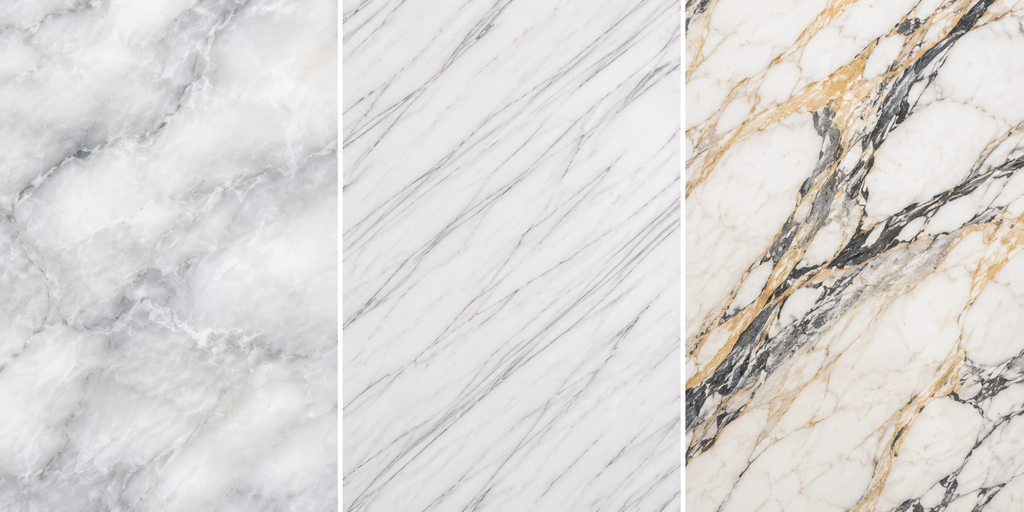
Veins are what people remember about marble, and they also decide where the eye goes. Geologically, veins are calcite-filled fractures in the rock.
Soft, cloudy veining recedes. It suits large floors and bedrooms, where the stone should calm the space. Fine linear veining adds rhythm and makes a corridor feel longer. Bold, dramatic veining pulls attention at once, so it belongs in one controlled place, such as a feature wall, a reception desk or a vanity panel.When working with mirror-image slabs, Italian marble bookmatching for luxury interiors turns dramatic veining into a symmetrical focal point. Brecciated stone, made of angular fragments in a binding matrix, reads as more textured and architectural than any of these.
Direction is a design choice. Vertical veins add height to a wall, and horizontal veins widen a narrow room. On a floor, the pattern should lead toward the main view rather than across the doorway.
Vein colour matters too. Grey veins feel cool and graphic, while gold or brown veins add warmth and sit naturally beside brass, timber and warm lighting. Strong veining on every surface makes the surfaces compete, so pair one dominant surface with quieter ones.
Surface Finishes: The Same Stone in Three Moods
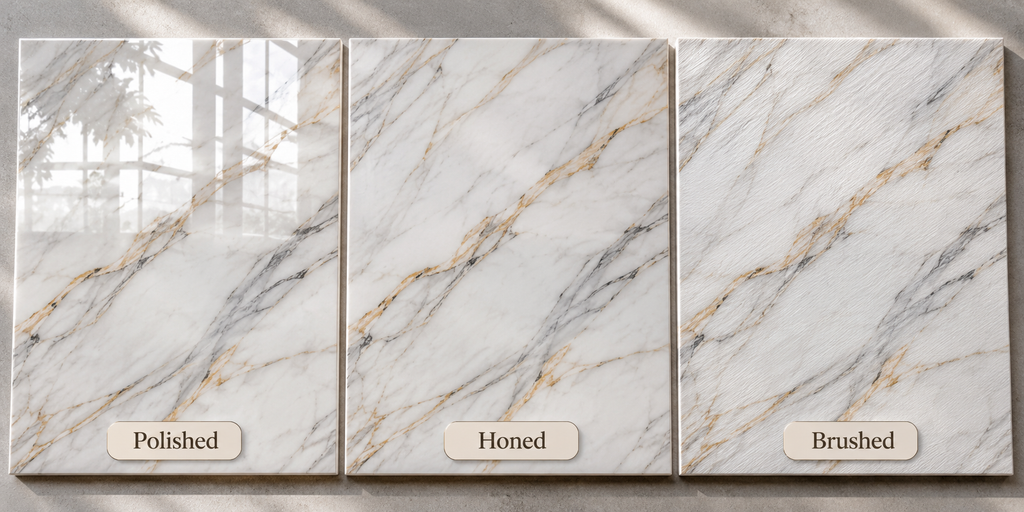
A finish changes how stone handles light, and light is what a room is made of.
A polished surface reflects. It deepens colour, sharpens veins and makes a space feel formal and bright. It also shows scratches and etching sooner, so it suits lobbies, feature walls and lightly used rooms better than a busy kitchen.
A honed surface is matte and soft. It lowers the contrast between vein and background, hides wear better and feels calm underfoot, which is why it works in bathrooms, bedrooms and living areas. A brushed surface adds light texture and grip, useful on terraces and in wet zones.
Finish and veining also affect each other. A subtle vein under a polished finish can look flat, while a strong vein under a honed finish can look quieter than you intended. Check the actual finished slab in the room’s own light before confirming the order, because showroom lighting rarely matches site lighting.
Matching Marble, Veining and Finish to Each Space
Put the three decisions together room by room.
- In a lobby or living room, use a softly veined stone on the floor, polished or lightly honed, with one bolder slab as the feature wall.
- Bedrooms suit quiet cloudy veining in a honed finish, which keeps the surface restful.
- For bathrooms, choose a honed or brushed floor for grip, with a polished vanity or wall panel where drama is wanted.
- Kitchen counters work best in a dense, honed stone, with care taken over sealing, since marble can etch.
- On staircases and passages, pick linear veining that follows the direction of travel.
RRM Marbles imports stone from Italy, Spain, Turkey, Greece and Brazil, and its in-house CNC and waterjet facility produces custom cuts and book-matched panels. To see how slab selection, vein orientation and custom fabrication come together in completed residences, explore our luxury stone projects across India.
Conclusion
Marble becomes luxury through the decisions around the slab: which stone is chosen, where its veins travel and how its surface meets the light. That’s why the best marble supplier in India will make those three decisions with you. When you make them together, with full slabs in front of you, the finished room looks designed rather than assembled. To start, explore the Imported Marble collection at RRM Marbles and share your project brief with the team.
Frequently Asked Questions
Why does marble selection matter beyond colour?
Undertone, scale and origin decide how the stone looks against your other materials and across the full area it covers.
Which veining suits a large living room?
Soft, cloudy veining usually works best on a large floor, with one bolder slab kept for a single feature surface.
Does vein direction change how a room feels?
Yes. Vertical veins add height, horizontal veins widen a narrow room, and floor patterns can lead the eye toward a view.
Is polished or honed marble better for a home?
Polished suits formal, lightly used areas. Honed suits bathrooms, bedrooms and living spaces where a calm look and easier upkeep matter.
Can an installed finish be changed later?
Often, yes. A specialist can re-hone or re-polish installed marble, though results depend on the stone’s condition and remaining thickness.
Is marble practical in a kitchen?
It can be, in a honed finish and properly sealed. Acidic spills and cleaners can etch the surface, so wipe them promptly.
Why view full slabs before ordering?
Full slabs show how veining repeats, where heavy movement sits and how the finish looks in your own light. Small samples cannot.
How do I begin a project with RRM Marbles?
Browse the imported marble page, then send your project brief through the contact page. The team aims to respond with a curated slab selection within 48 hours.