
Bookmatching turns two neighbouring slabs into one mirrored composition, which is why feature walls in luxury homes hold the eye. A single slab of Italian marble shows a vein pattern. Two consecutive slabs opened like a book show a pattern that reads as one design across a whole wall, island or floor.
This guide explains how bookmatching works, which stones suit it, how slabs are cut and sequenced, where to use it, and how to plan it. If you are comparing an Italian Marble Supplier India for a villa, hotel or showroom project, it gives you the questions to ask before you approve a single slab.

What Bookmatching Is and How the Mirror Effect Forms
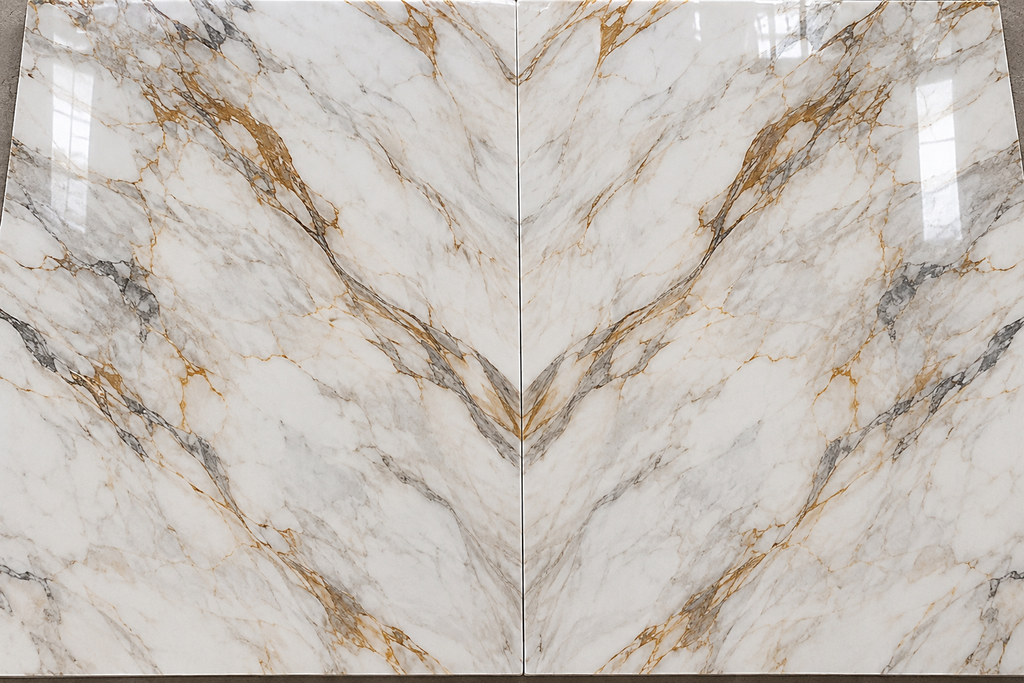
Bookmatching is the practice of arranging consecutive slabs so their patterns mirror each other along a shared edge. A saw cuts a marble block into slabs one after another, and slabs that come off next to each other carry almost the same vein structure.Open the first slab like a book cover and the second becomes its reflection.
Several layouts are possible. A two-slab match creates one mirrored seam. A four-slab match mirrors the pattern in both directions and forms a diamond or butterfly shape at the centre. Slip matching shifts slabs sideways instead of flipping them, so the vein direction stays constant, which suits long linear stones. Vertical veins read as a tall feature wall, while horizontal veins suit a long island or a floor run.
The pattern belongs to the block, so slabs from different blocks will not match. This makes bookmatching a decision for the slab-selection stage, long before installation begins.
Choosing Italian Marble Slabs That Suit Bookmatching
Stones with clear, directional veining give the strongest match. Statuario and Calacatta carry bold grey or gold veins on a white ground, so the mirrored pattern shows from across the room. Carrara has softer, more scattered veining, which gives a calmer match and suits larger, quieter surfaces. Botticino, a warm beige marble, suits panels where continuity of tone matters more than drama.
Check three things before you choose:
• Vein density: Widely spaced veins mirror cleanly, while dense veining can look busy.
• Background tone: A consistent ground colour across both slabs avoids a patched look.
• Slab size and thickness: The mirrored area is only as large as the slabs allow.
Buyers looking for Italian marble slabs in India will find a mix of selected and commercial grades. A premium Italian marble collection keeps slabs in cutting order from the same block, and that order is what makes a match possible. Ask to see full slabs laid out together, not a sample tile.
How Slabs Are Cut, Sequenced and Matched
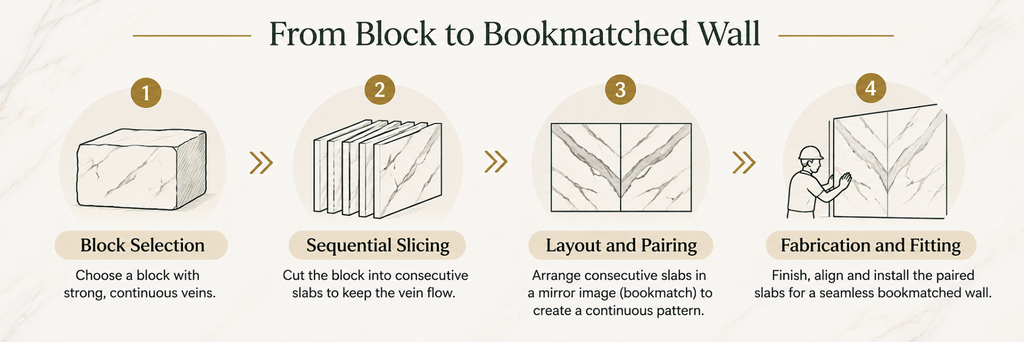
The work runs in four steps, and the order matters because each step locks in the next.
1. Block selection. The team picks a block whose vein character fits the design.
2. Sequential slicing. The saw cuts the block into slabs in order, and the crew numbers each slab as it comes off.
3. Layout and pairing. The team lays the slabs out face up and decides which to pair, which to flip, and where the seam will fall.
4. Fabrication. Edges are trimmed and polished, and CNC and waterjet cutting shape each panel to the drawing so the seam lands on the centre line of the wall or island.
The layout step is where the team catches most mistakes. Moving a slab one position changes the whole pattern, so photograph the approved layout and keep it with the order. If fabrication damages a slab, its pair suffers too, so ask how your supplier handles replacements before work starts.
Where Bookmatching Works Best in Luxury Interiors
Feature walls give the most dramatic return. A bookmatched wall behind a sofa, bed or reception desk gives the room a focal point without extra decor. In a hotel lobby, the match can run floor to ceiling behind the reception desk and set the tone for the whole space.
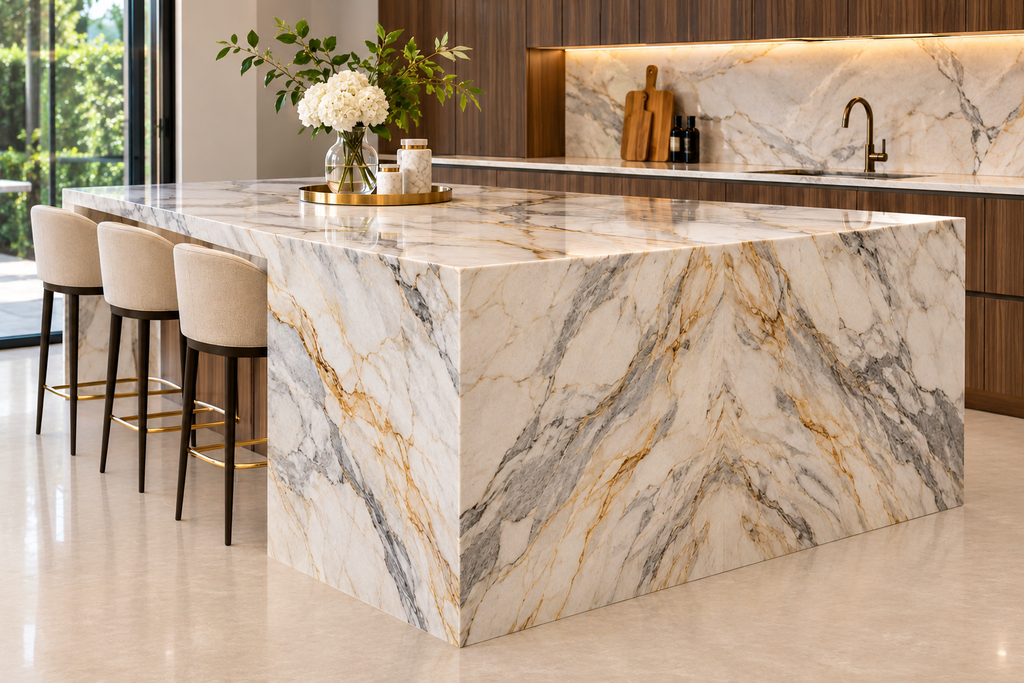
Kitchen islands with waterfall edges carry the pattern over the top and down the sides, so the veins keep running around the corner. Fireplace surrounds, staircase risers, lift lobbies and vanity backs suit the technique for the same reason: people look at them directly.
You can bookmatch floors too, most often in entrance foyers where a central pattern greets visitors.Large floor areas use many slabs from one block, so confirm the quantity early.
To see what is possible, browse the imported marble collection at RRM Marbles. It lists Italian Statuario, Calacatta, Carrara and Botticino, and describes in-house CNC and waterjet fabrication for book-matched feature walls.
Planning, Installation and Care
Start with the drawing. Give your imported Italian marble supplier the wall height, width, seam positions and any cut-outs for sockets, switches or sinks, so the pattern avoids them. Approve slabs in person or through full-slab photographs, and keep the approved set numbered through delivery.
Italian marble price in India for bookmatched work depends on the stone variety, the number of slabs used, the wastage from trimming the match, and the fabrication involved. Bookmatching uses more stone than a standard layout because the pair must come from the same block, so ask for a quote that lists these items separately.
On site, installers need tight, even joints and level alignment, because a small shift at the seam breaks the mirror. A dry fit before fixing catches errors while they are still cheap to correct.
After installation, seal the surface and clean it with a pH-neutral cleaner. Wipe acidic spills such as lemon juice or wine at once, since marble etches under acids and a bookmatched wall shows every mark.
Conclusion
Bookmatching succeeds when the planning happens before the cutting. You need consecutive slabs from one block, a stone with clear veining, a drawing that places the seam on purpose, and installers who treat the joint as the most visible line in the room.
RRM Marbles works as an Italian marble supplier in India with direct partnerships with Italian quarries. Visit our page to see the stones on offer, then send an enquiry with your drawings so the design consultants can curate a slab selection for your project.
FAQ
What is bookmatching in marble?
It is the arrangement of two or more consecutive slabs so their veins mirror each other along a shared edge, like the facing pages of an open book.
Which Italian marble is best for bookmatching?
Statuario and Calacatta give the boldest results because of their strong veins. Carrara gives a softer match, and Botticino suits warm, even-toned panels.
How many slabs do I need?
A minimum of two. A four-slab butterfly match needs four, and larger walls need more, depending on slab size and wall dimensions.
Can any marble be bookmatched?
Technically yes, but plain or randomly patterned stone shows little mirror effect. Choose a stone with defined, directional veins.
Does bookmatching cost more than a standard layout?
Usually yes, because it consumes more stone, needs slabs from one block, and involves careful layout and fabrication. Ask for an itemised quote.
Can bookmatched marble be used on floors?
Yes, mostly in foyers and feature areas. Use consecutive slabs, plan the quantity early, and check the finish suits the foot traffic.
Where is the match decided?
Slabs are sliced and numbered in sequence at the source. The final pairing is decided during layout, before fabrication starts.
How do I care for a bookmatched marble wall?
Seal the surface, clean with a pH-neutral cleaner, and wipe acidic spills quickly to avoid etching.