
Two slabs cut from the same block of Italian marble can look like different stones once the surface is finished. One reflects ceiling lights like still water. The other absorbs them and reads as soft and quiet. Finish changes colour depth, grip, upkeep and the way marble ages, so it deserves as much thought as the stone itself.
This guide covers the three finishes most often specified in modern interiors: polished, honed and brushed. If you are briefing an Italian marble supplier India architects and homeowners rely on, understanding each finish helps you ask the right questions and avoid a mismatch after installation.
What a Finish Actually Changes
A finish is the last treatment a slab receives after cutting. Abrasives of decreasing coarseness work the face until it reaches the intended smoothness. Polishing continues until the surface turns glossy. Honing stops earlier and leaves a smooth, matte face. Brushing uses abrasive brushes that wear the surface unevenly and leave a fine texture.
The stone underneath does not change. Its mineral makeup, veining, and hardness stay the same. What changes is how light behaves on the face, how much grip a floor offers, how readily scratches and etch marks show, and how often the surface needs sealing. Premium Italian marble slabs such as Statuario, Calacatta, Carrara and Botticino accept all three finishes, though each stone wears them differently.
Polished Finish: Depth and Gloss
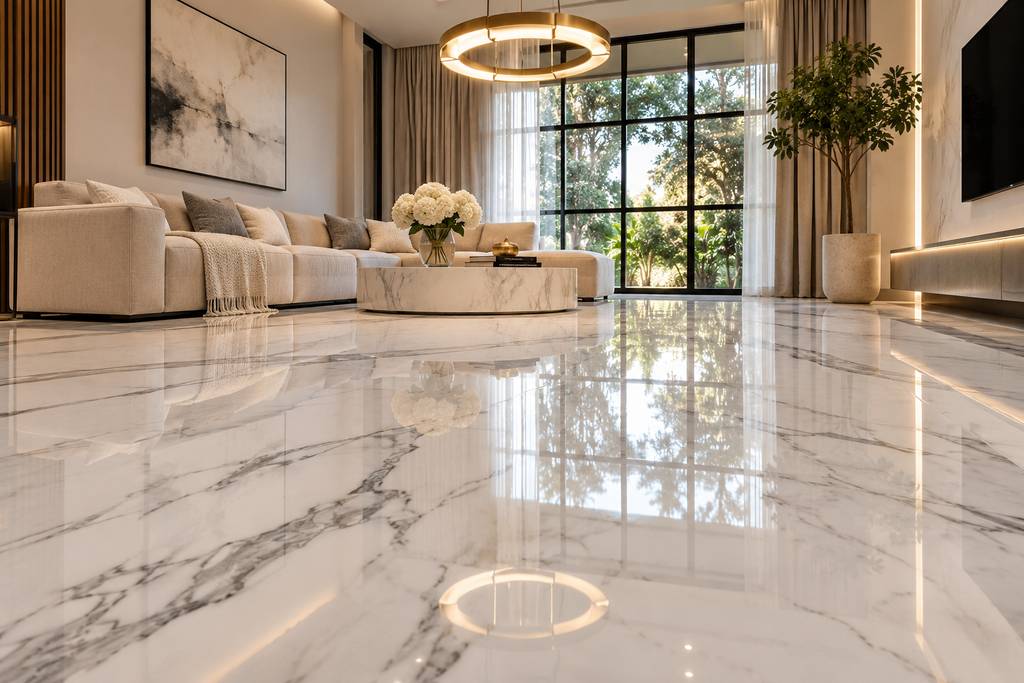
Polishing gives marble its mirror-like face. The gloss pushes colour deeper and makes veining look sharper, which is why polished Calacatta and Statuario dominate formal living rooms, lobbies and feature walls. A polished floor also bounces light into rooms that get little daylight.
The trade-off is visibility. A dull etch mark from a drop of lemon juice or a splash of vinegar stands out against a glossy face, and fine scratches catch light from low angles. Polished marble also turns slippery when wet, so it suits dry interiors better than bathroom floors or entrances that see rain.
Care is simple but regular. Wipe spills quickly, use a pH-neutral stone cleaner, and plan on professional re-polishing when traffic dulls the busiest paths. For luxury Italian marble designs built around book-matched walls or a continuous veined floor, polish is usually the finish that shows the pattern at full strength.
Honed Finish: Soft, Matte and Forgiving
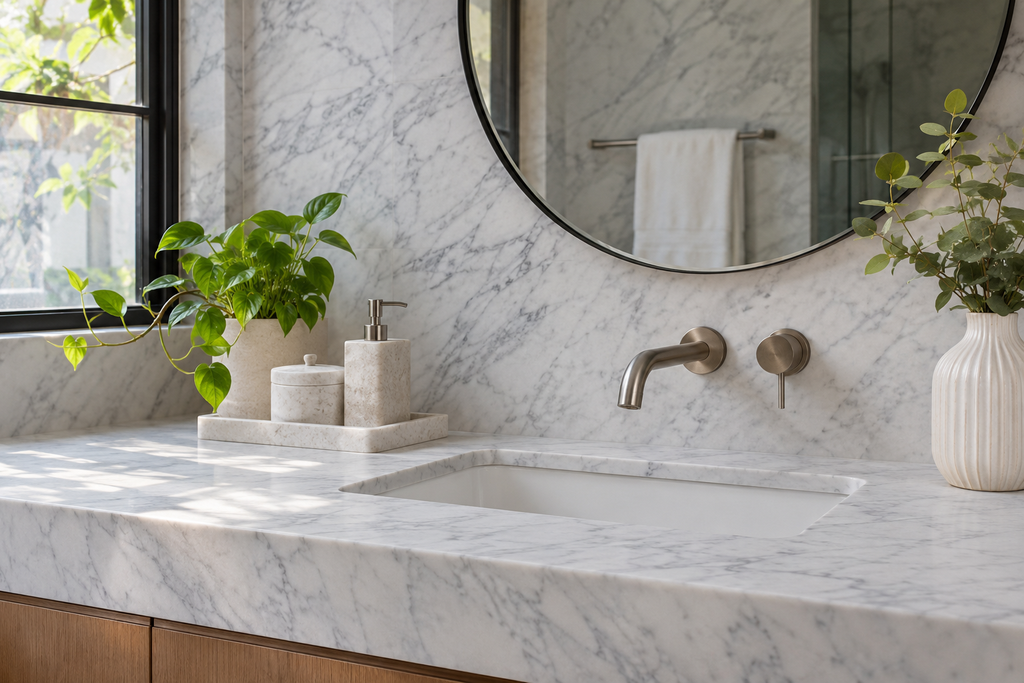
Honing stops the abrasive process before the surface gains any shine. The result is a smooth, satin-matte face that reflects little light. Colours look slightly softer and lighter, and veining reads as calm rather than dramatic. Minimal and Japandi-style interiors favour this quiet look.
Honed marble hides the wear that polished marble shows. Etch marks blend into the matte surface and small scratches fade into it. The face also gives better grip, which makes it a sensible choice for bathroom floors, vanity tops, hallways and kitchen counters.
The catch with that forgiveness is porosity. The open surface absorbs liquids faster, so honed marble stains more readily and needs sealing at regular intervals. Wipe oil, wine and coffee quickly. An imported Italian marble collection in a honed finish suits owners who accept a little upkeep in return for a surface that looks relaxed and lived-in.
Brushed Finish: Texture With Character
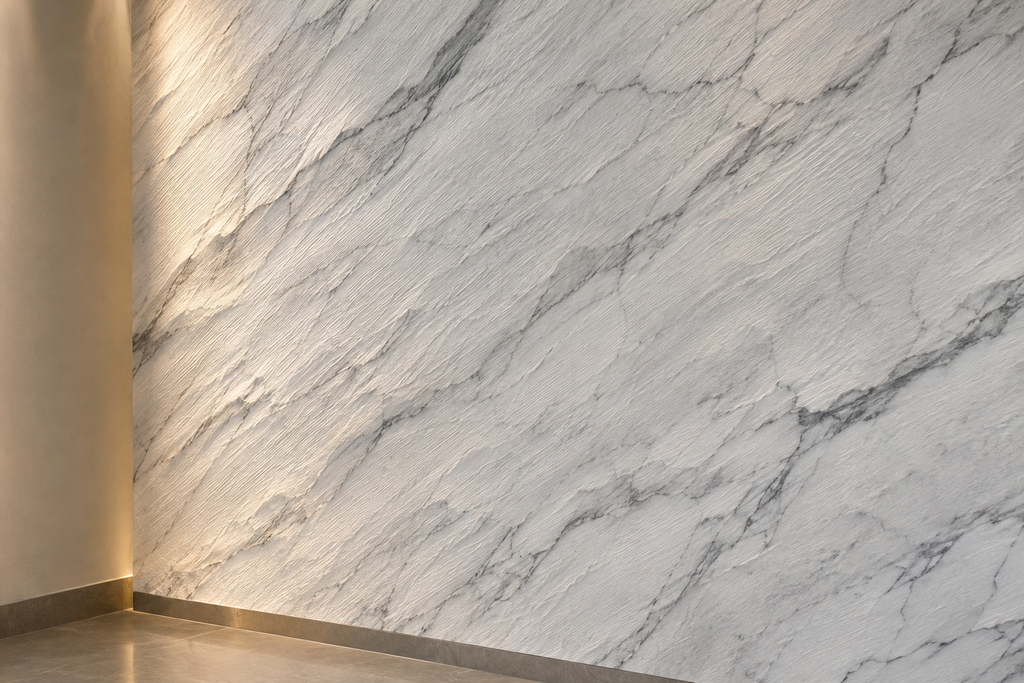
Brushing is the least common of the three on Italian marble and the most tactile. Abrasive brushes rub the face and leave a fine, slightly uneven texture with a matte, aged look. Your fingers register the surface before your eye does.
The texture gives good grip, so brushed marble works on bathroom and shower floors, steps, verandas and covered terraces. It also masks scuffs well, and on feature walls it adds shadow play when side lighting rakes across the surface.
Brushed marble holds dust in its texture, so cleaning calls for a soft brush or damp cloth rather than a quick wipe. Availability also varies by stone and thickness. Confirm with your supplier that a brushed face is possible on the exact slab you have chosen, because not every Italian variety brushes evenly.
Choosing the Right Finish for Each Room
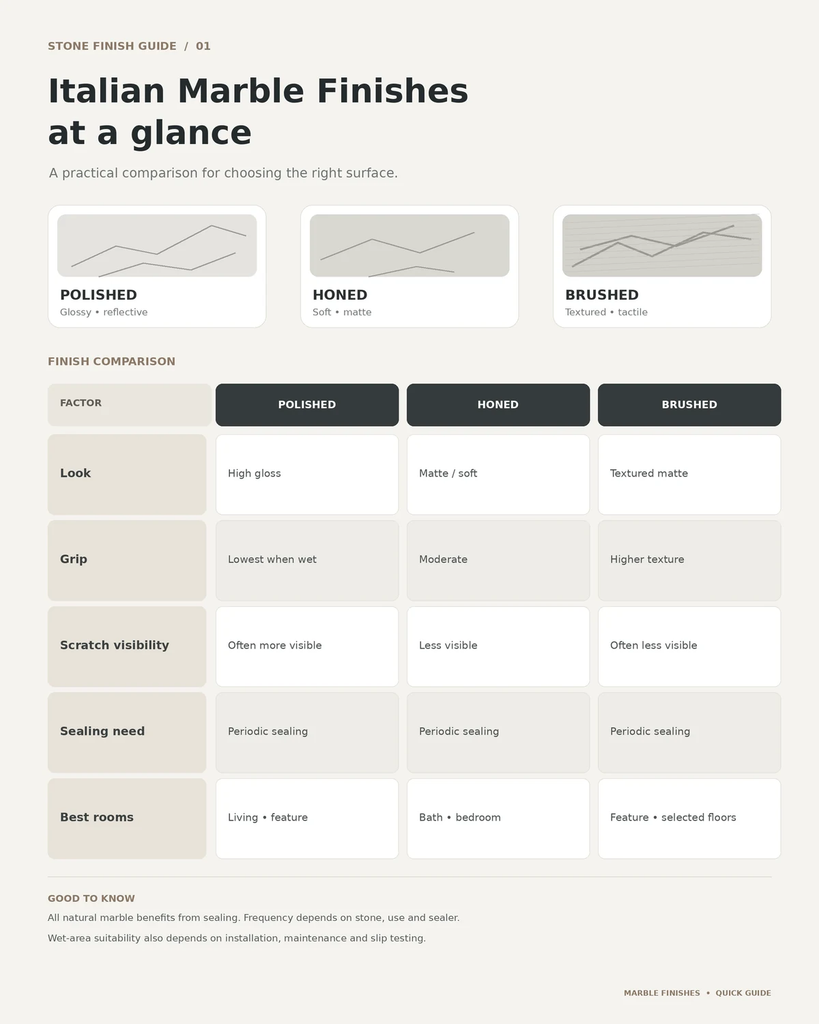
Match the finish to what the room does. Living rooms, dining areas and entrance lobbies suit polish when the aim is formal elegance. Kitchens and bathrooms lean toward honed, where spills and water are routine. Wet zones, steps and outdoor-facing floors benefit from brushed texture. Feature walls can take any of the three, since nobody walks on them.
Keep one finish across a continuous floor. Mixed finishes on the same plane read as a mistake because the same slab looks lighter or darker under each. Mixing across surfaces works well: a polished wall behind a honed floor adds contrast without confusion.
Before you commit, ask for the same slab in two finishes and view both under your room’s real lighting, morning and evening. When you compare Italian marble dealers in India, that side-by-side sample tells you more than any catalogue photo. RRM Marbles also runs a Marble Visualizer on its site that previews finishes in room settings.
Conclusion
Polished marble gives depth and drama, honed gives calm and forgiveness, and brushed gives grip and texture. None wins in general. Each wins in a particular room, at a particular level of foot traffic, for an owner with a particular tolerance for upkeep.
Settle the finish early, alongside the stone, and view samples in your own light. To see which Italian varieties are available and how RRM Marbles finishes them in a polished or honed surface, visit the Imported Marble collection page and send your project brief through the enquiry form.
FAQ
What is the difference between polished and honed Italian marble?
Polished marble has a glossy, reflective face that deepens colour and veining. Honed marble has a smooth matte face that reflects little light. The stone is the same, so the difference lies in look, grip, and upkeep.
Which finish is best for Italian marble flooring?
Honed or brushed suits most floors because they grip better and hide wear. Polished works in dry, low-traffic rooms such as living areas, where its gloss is the point.
Is polished marble slippery?
Yes, when wet. In bathrooms, entrances, and any area exposed to water, choose honed or brushed, or limit polish to walls.
Does honed marble stain more easily?
Its open surface absorbs liquids faster than polished marble, so stains set in sooner if spills sit. Regular sealing and quick wiping keep it in good shape.
Can a finish be changed after installation?
Often yes. Specialists can hone down a polished surface or polish up a honed one, though dust and downtime make it better to choose the first time correctly.
How do I clean each finish?
Use a pH-neutral stone cleaner and a soft cloth on all three. Avoid vinegar and lemon-based products. Brushed surfaces may also need a soft brush to lift dust from the texture.
Do all Italian marbles come in all three finishes?
Most take polished and honed. Brushed depends on the stone, its thickness, and the supplier’s equipment, so confirm it for your chosen slab.
How should I choose a supplier?
Pick an Italian marble supplier in India you can trust: one that shows full slabs, provides samples in more than one finish, and explains sealing and care. Judge Italian marble dealers in India on those points, not on photographs alone.