
Roman limestone and travertine look alike from across the room. Both come in warm beige tones, both suit large floors and facades, and both appear side by side in many project drawings. Up close, they behave differently, and that gap decides how a floor ages, how it feels underfoot, and how much care it needs.
This guide compares the two on texture, durability, and applications so you can match the stone to the space. It also covers what to check when you look for a Roman Limestone Supplier India buyers can rely on. You can see the RRM Marbles range on the limestone collection page.
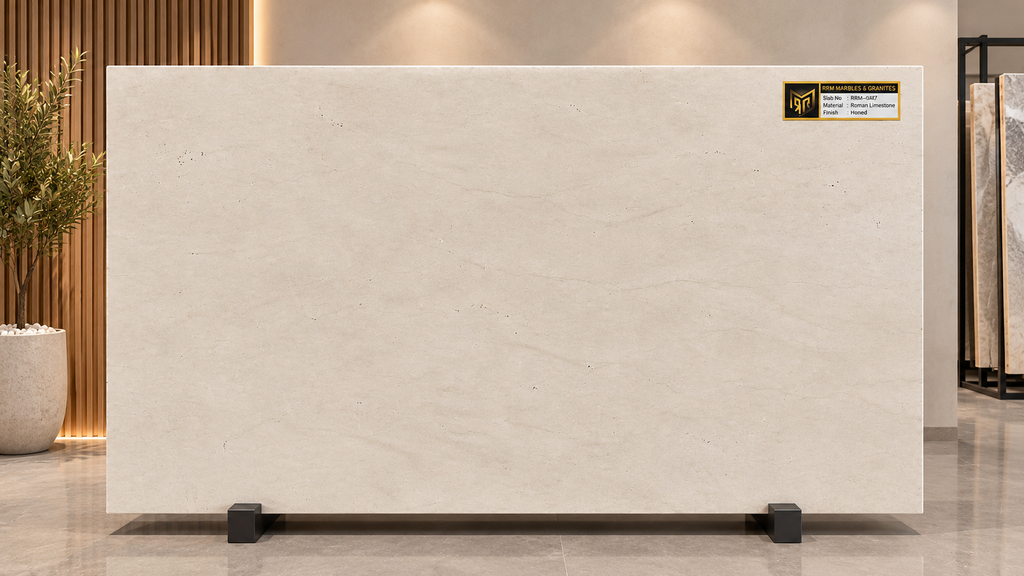
Section 1: Origin and Formation, How Each Stone Is Made
Both stones are limestone, so both are mostly calcium carbonate. The difference lies in how that calcium carbonate collected.
Roman limestone is a sedimentary rock. Shells, coral, and other marine material settled on ancient seabeds and compacted into dense layers over a very long time. The result is a fine, even grain that stays consistent across a slab, with a body that feels solid when you cut or polish it.
Travertine forms at mineral springs. Warm, mineral-rich water rises to the surface, releases carbon dioxide, and leaves calcium carbonate behind. Gas bubbles and plant matter trapped in the deposit leave small voids, and the layers build up as horizontal bands. That is why travertine is porous and banded, while Roman limestone is closed and uniform.
Trade names blur the line between the two, so ask any supplier to confirm in writing which stone a slab is before you order.
Section 2: Texture and Appearance
Roman limestone has a smooth, quiet surface. Expect soft cloudy movement, occasional fossil flecks and a colour range of cream, sand and grey beige. Slabs from one batch match closely, which helps on large floors where you want no visible patchwork. It takes honed, brushed, sandblasted and antique finishes well, and the sheen stays low, so light does not glare off the floor in a bright room.
Travertine has more surface drama. Vein-cut slabs show long linear bands, while cross-cut slabs show a cloudy pattern. Pores and pits run through the face. They are either filled and honed for a smoother feel or left open for a rustic look. Colours range from ivory and beige to walnut and silver.
If you want calm and consistency, Roman limestone suits you. If you want visible character in the stone itself, travertine delivers it.
Section 3: Durability and Maintenance
Both stones are calcium carbonate and sit at roughly 3 to 4 on the Mohs scale, so both react to acids. Lemon juice, vinegar, cola, and bathroom cleaners can etch either surface. Neither suits an untreated kitchen counter that sees daily spills.
Roman limestone is denser with fewer voids. It resists staining better once sealed, holds its edges and corners well, and wipes clean easily. Travertine’s pores can collect dirt and moisture, and the rims of open pits can chip under heavy traffic. Filled and sealed travertine performs far better. Travertine also has a long record outdoors, since the Colosseum in Rome was built from it.
For both stones, seal after installation, clean with a pH-neutral product, and put mats at entrances to catch grit. In humid and monsoon-heavy regions, choose a honed, brushed, or textured finish for wet areas so the surface stays slip-resistant. Hard water can leave white salt deposits on stone, so wipe standing water from bathroom floors.
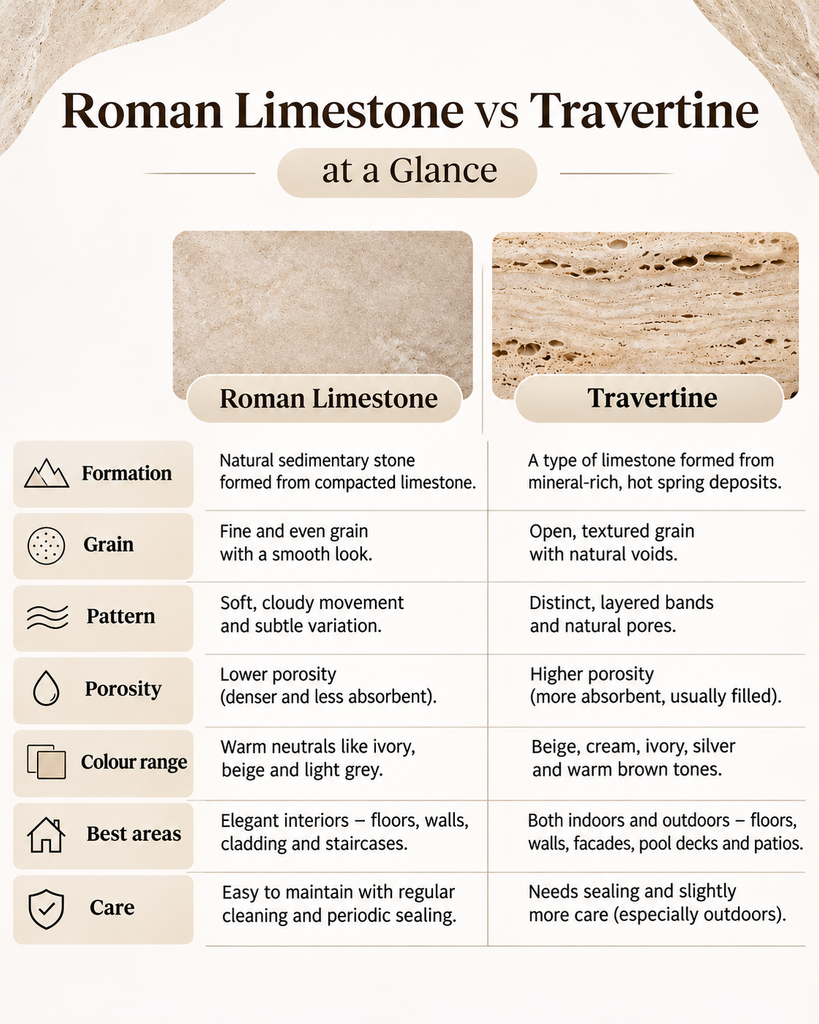
Section 4: Applications and Roman Limestone Flooring Designs
Roman limestone suits interiors that need one continuous, calm surface. Popular Roman Limestone Flooring Designs include:
• Large format honed tiles that run from the living room into a covered terrace
• Modular or random-length patterns that give the floor a European feel
• Brushed staircase treads and landings
• Wall cladding, fireplace surrounds and bathroom walls
Travertine works well where texture and weather matter. Common uses are pool surrounds, patios, garden paths, exterior facades and tumbled floors in verandas. Vein-cut travertine also works indoors, where its linear bands lead the eye along a corridor or across a lobby.
For a home that moves between indoor and outdoor spaces, many designers pair the two: Roman limestone inside, travertine outside, in matching tones so the transition feels planned.
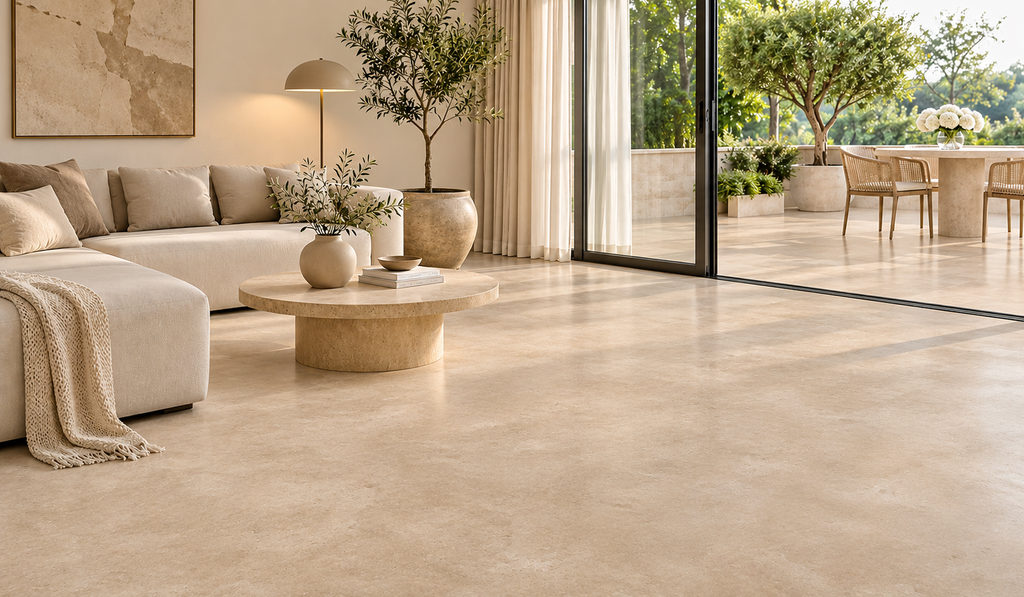
Section 5: How to Choose, Supplier Checks and Price Factors
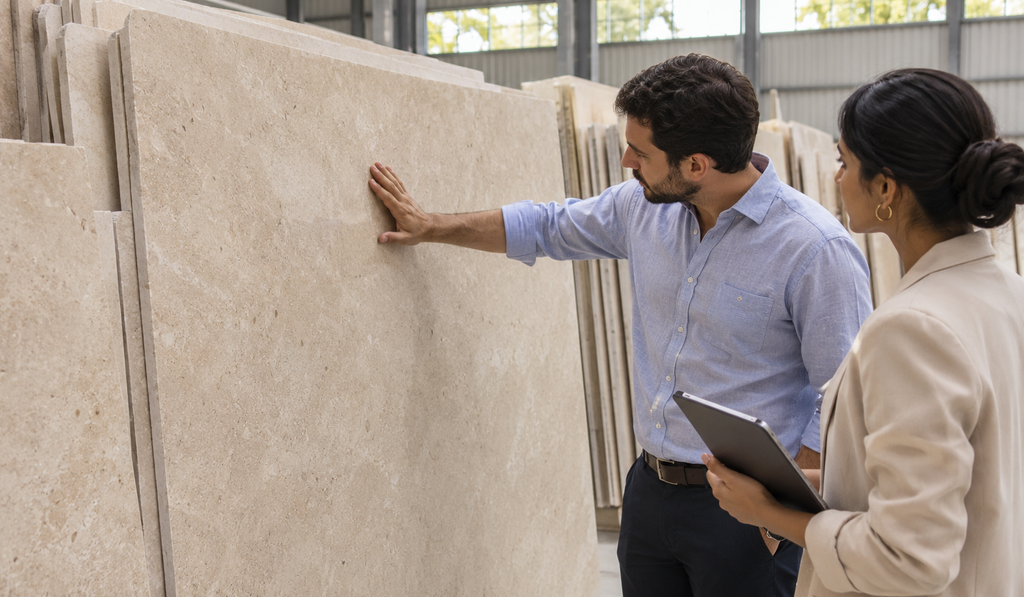
Choose Roman limestone for uniform floors, minimal visible pattern and a refined interior. Choose travertine for banded character, outdoor use and textured finishes. When you shortlist Roman Limestone Slabs India projects can use, check these points:
• Batch consistency: view several slabs from the same lot, not one sample tile
• Thickness and calibration: uneven slabs cause lippage on large floors
• Finish samples: see honed, brushed, and antique finishes in daylight
• Sealing and care guidance: ask for written instructions
• Cutting and delivery: confirm cut-to-size capacity and careful handling of large slabs
Roman Limestone Price India varies with grade, slab size, thickness, finish, batch selection, quantity, fabrication, and transport distance. Ask for a quotation that lists each factor, so you can compare like with like. A Premium Roman Limestone Collection should come from a consistent source with quality checks, so ask where the slabs come from and how they are graded.
Conclusion
Roman limestone and travertine share a chemistry and a warm palette, but they differ in grain, porosity, and finish. Roman limestone gives a dense, even surface for calm interiors. Travertine gives visible banding and suits wet and outdoor areas. Match each stone to the space, seal it after installation, and keep acids away from it.
To see slabs, finishes and available colours, visit the RRM Marbles limestone collection and send your project details to our team to request samples.
FAQ
Is Roman limestone the same as travertine?
No. Travertine is a type of limestone formed at mineral springs, with natural pores and banding. Roman limestone forms in marine sediment and has a denser, more uniform grain.
Which stone is more durable?
Roman limestone is denser and resists staining better. Filled and sealed travertine also performs well and has a long record in outdoor use.
Can Roman limestone be used outdoors?
Yes, on facades and sheltered terraces with a brushed finish and the right sealer. For wet, open areas such as pool decks, textured travertine is the usual pick.
Which stone suits flooring in humid climates?
Either works with a honed or brushed finish and proper sealing. Use a textured finish in wet areas and clean with a pH-neutral product.
Does Roman limestone stain?
It can if left unsealed. Seal after installation, wipe spills quickly, and keep acidic liquids away from the surface.
What finishes are available?
Honed, brushed, sandblasted, antique, and tumbled finishes are common. Availability varies by batch, so ask for physical samples before you decide.
What affects Roman limestone price in India?
Grade, slab size, thickness, finish, batch selection, quantity, fabrication, and transport distance. Ask for an itemised quotation.
How do I order from RRM Marbles?
Visit the limestone collection page, then send your project brief and quantity through the contact form to request samples and a quotation.