
Italian marble has been the benchmark for natural stone for more than two thousand years. Roman builders used it, Renaissance sculptors carved it, and architects across India now specify it for villas, hotels, and temples. Yet many buyers know only the phrase “Italian marble” and little about what separates one slab from another. A Statuario slab and a Botticino slab come from different quarries, look nothing alike, and suit very different rooms.
This guide covers where Italian marble comes from, which varieties matter, and why the stone behaves as it does. It also gives you a checklist for when you shortlist an Italian marble supplier in India.
1. Where Italian Marble Comes From
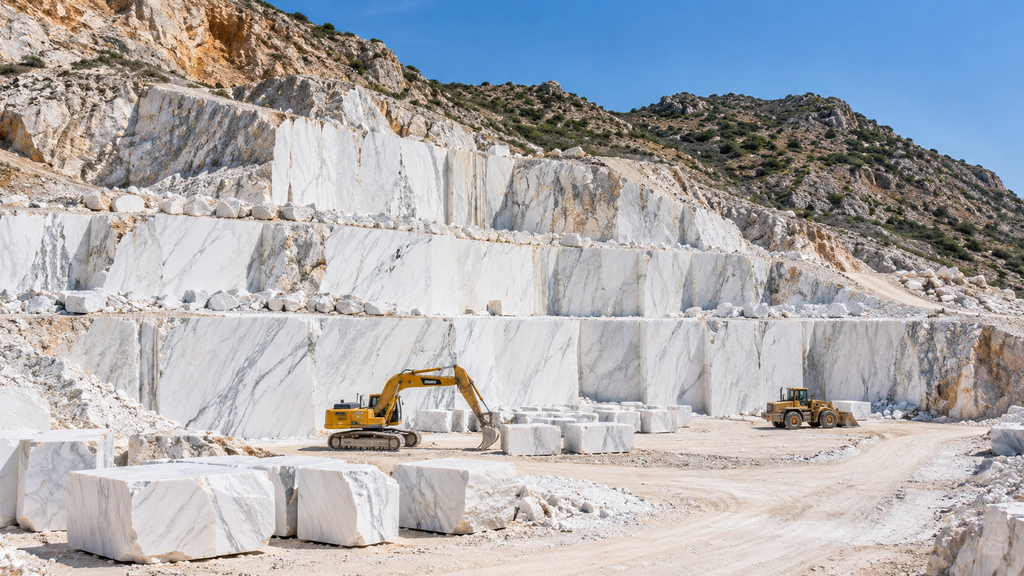
Marble begins as limestone. Heat and pressure deep in the earth’s crust recrystallise the limestone into interlocking calcite crystals, and impurities such as clay, graphite and iron oxide stretch into the veins you see on a finished slab.
Italy’s most famous deposits produce the white and cream stones buyers know by name, and the stone from each deposit carries its own colour, grain and hardness. Quarrying there dates to Roman times, and Michelangelo carved the David from Carrara marble in the early 1500s. Botticino and Rosso Verona come from separate quarries, each with its own character.
Each region has its own geology, so colour, grain and hardness change from quarry to quarry. Italian blocks are also cut and finished by long-established mills, which is why slabs tend to arrive with even thickness and a consistent polish. Quarries release only limited lots of the best blocks, so the same variety can look different from one shipment to the next. This is why buyers who care about colour match order all the slabs for a room from a single lot.
2. The Main Varieties in a Premium Italian Marble Collection
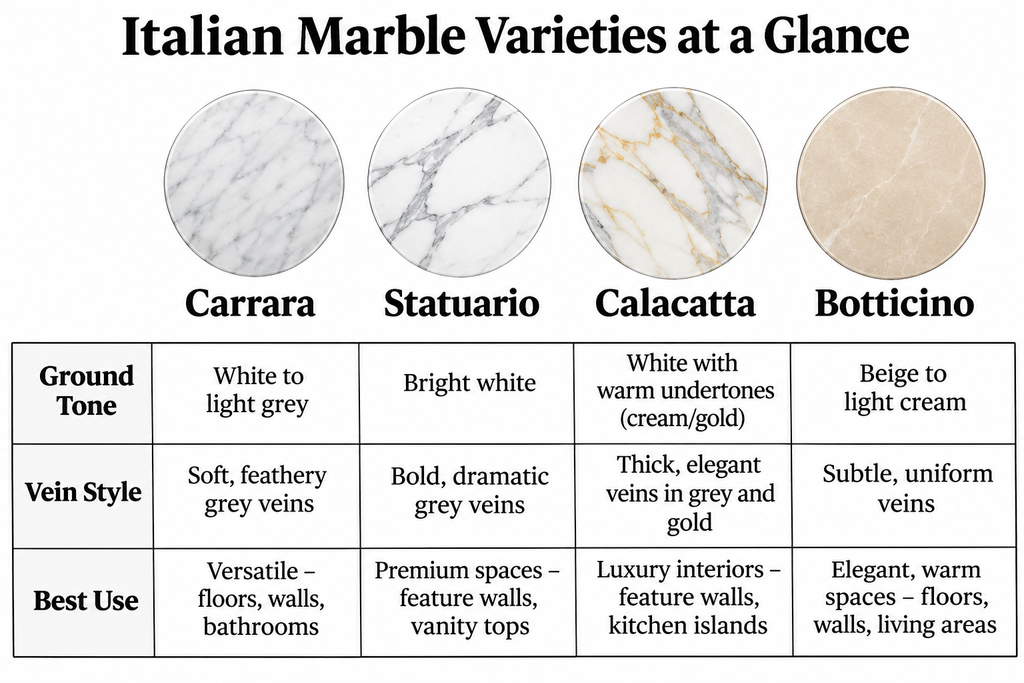
Carrara. The most widely available Italian white. It has a pale grey-white ground with soft, feathery veins and a fine grain. It is easier to source than the rarer whites, so it suits large floors and wall cladding.
Statuario. A cleaner white than Carrara, with bold grey veins in dramatic patterns. Less of it is extracted, so good lots are scarce and in demand.
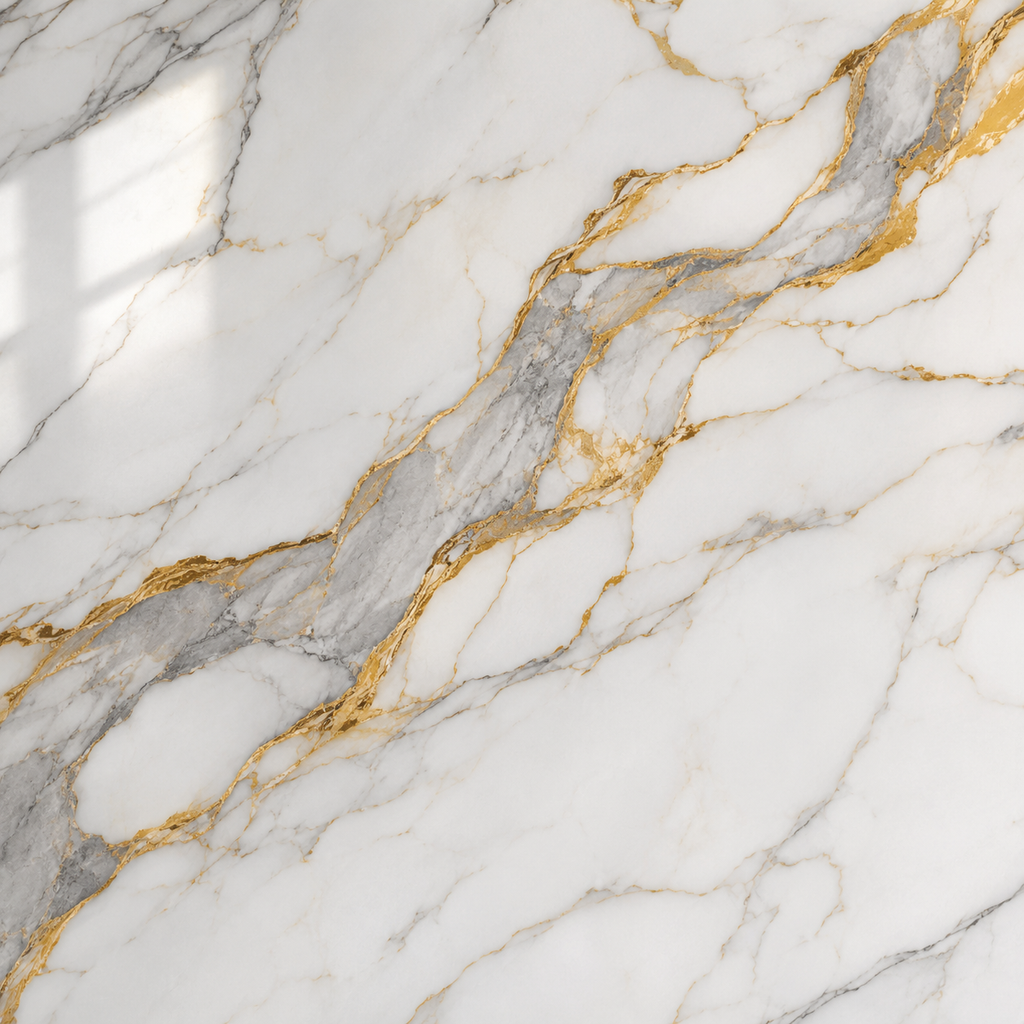
Calacatta. A white ground crossed by thick, irregular veins in grey, gold or brown. The veins are wide and few, which makes Calacatta the first pick for feature walls and bookmatched kitchen islands. Slabs vary a lot, so choose from the actual slab rather than a sample.
Botticino. A warm beige to cream marble with fine veins. It suits large floors and homes that want warmth instead of stark white, and it pairs well with timber and brass.
3. Unique Characteristics of Italian Marble
Fine grain and polish. Smaller calcite crystals give a denser surface that takes a deep, even gloss. Coarser stone polishes less sharply.
Veining. Veins are the stone’s signature, and no two slabs match. Thin, straight veins read formal and quiet. Wide, curved veins read bold.
Translucency. High-purity white marble such as Statuario lets light travel a few millimetres into the surface, which gives the stone a soft glow under daylight and warm lighting.
Hardness. Marble is calcite, rated about 3 on the Mohs scale, against 6 to 7 for granite. Acids from lemon, vinegar and cola etch a polished surface and leave dull marks. A honed finish hides these marks better, and a penetrating sealer slows staining. Clean with a pH-neutral cleaner.
Temperature. Marble stays cool underfoot, which helps in hot climates.
Weight. A 20 mm slab weighs roughly 54 kg per square metre, so upper floors and wall cladding need planning with your engineer.
4. Italian Marble Flooring Designs and Slab Applications
Italian marble flooring designs usually follow a handful of proven layouts:
• Large-format tiles with tight joints. Carrara or Botticino in 1200 x 600 mm tiles gives a calm, near-seamless floor.
• Diagonal layout. Tiles set at 45 degrees make a room feel wider.
• Chequerboard. Alternating white and dark stone suits entrance halls and passages.
• Border and medallion. Waterjet-cut inlays, such as a Statuario centre framed by Rosso Verona, suit foyers and temples.
Slabs open up uses that tiles cannot. Italian marble slabs in India are often bought for bookmatched feature walls, kitchen islands, vanities and staircases, where the vein flows across one continuous surface. Ask for numbered slab photos so you can plan the flow before cutting.
Use polished marble in living areas, and honed or leathered marble in kitchens and bathrooms, where wet feet make a gloss finish slippery.
5. Caring for Italian Marble and Choosing a Supplier
Marble keeps its look for decades when you treat it as the soft, porous stone it is. Four habits make the difference.
• Seal on schedule. Seal before use and again every one to two years, sooner in kitchens and bathrooms.
• Wipe spills fast. Lemon, tomato and cola mark polished marble within minutes.
• Clean gently. Dust-mop daily and damp-mop with a pH-neutral cleaner. Avoid vinegar and bleach.
• Catch grit. Entrance mats stop the grit that dulls a polished floor.
Good care starts with good stone, so the supplier you pick matters as much as the variety.
When you compare an Italian marble supplier in India, ask for the quarry and lot name, numbered slab photos, and a written specification that states thickness, grade, finish and what the work includes: cutting, installation and sealing. RRM Marbles imports directly, cuts in house with CNC and waterjet, and installs across India. Its Imported Marble page is the place to request a quote.
Conclusion
Italian marble is a family of stones, not one product. Carrara offers versatility, Statuario and Calacatta offer drama, Botticino offers warmth, and Rosso Verona adds contrast. Match the variety to the room, choose the finish for how the space will be used, and judge slabs in person rather than from a catalogue.
If you are planning a floor, wall or kitchen in Italian marble, browse the RRM Marbles page and send your project brief for a slab selection and quote.
FAQ
What is Italian marble?
Marble quarried in Italy and used for floors, walls and sculpture. It is valued for fine grain, clear veining and a deep polish.
Which Italian marble is best for flooring?
Carrara and Botticino are the usual floor choices because they balance durability, availability and a calm pattern. Statuario and Calacatta suit smaller floors, borders and feature areas.
What is the difference between Statuario and Calacatta?
Statuario has a clean white ground with grey veins. Calacatta has thicker, bolder veins in grey, gold or brown and a more dramatic look.
How do I maintain Italian marble flooring?
Seal it before use and again every one to two years, wipe spills quickly, and clean with a pH-neutral cleaner. A restoration crew can re-hone etched areas.
Does Italian marble stain or scratch easily?
It can. Marble is soft and porous, so acids etch it and spills stain. Sealing, honed finishes and quick cleaning keep it in good shape.
Is Italian marble suitable for Indian homes and climate?
Yes. It stays cool underfoot in hot weather. Use honed finishes in kitchens and bathrooms and seal the stone before use.
How do I check that marble is genuinely Italian?
Ask the supplier for the quarry name, lot and slab numbers, and import documents. Direct importers can show these records.
Can I buy Italian marble slabs instead of tiles?
Yes. Slabs suit bookmatched walls, kitchen islands, vanities and staircases. RRM Marbles cuts slabs to your drawings in its in-house CNC and waterjet unit.