
Two slabs can carry the same name on a quote and still be very different stones. One holds its polish for decades. The other stains in the first monsoon, cracks along a hidden fissure, or arrives with veins that refuse to line up across a wall. Anyone shopping for premium imported marble in India benefits from knowing what actually separates them.
Quality is decided at the quarry, confirmed in testing, and protected through cutting, finishing, and shipping. This guide walks through five factors you can check before you pay, so a high price buys a better stone and not just a better brochure.
1. Quarry Origin and Block Selection
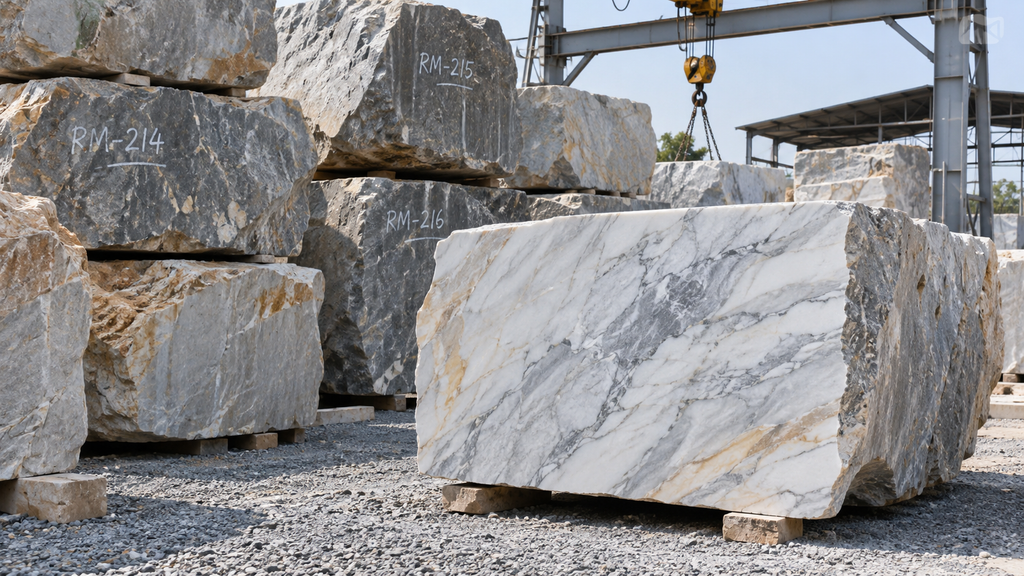
Every slab starts as a block, and the best blocks are chosen before a saw touches them. Italian quarries around Carrara supply Statuario and Calacatta. Botticino comes from Brescia in northern Italy. Spain’s Emperador is cut from the Murcia region. These names carry weight because the deposits are well mapped and consistent in grain.
Origin alone does not guarantee quality, though. Within one quarry, blocks vary in colour, fracture risk, and vein density. Premium suppliers inspect rough blocks in person, reject those with internal cracks or clay seams, and cut only the blocks that pass. Ask whether your slabs come from a single block, because slabs from one block share tone and veining far more closely than slabs mixed from several.
2. Veining, Colour Consistency and Grade
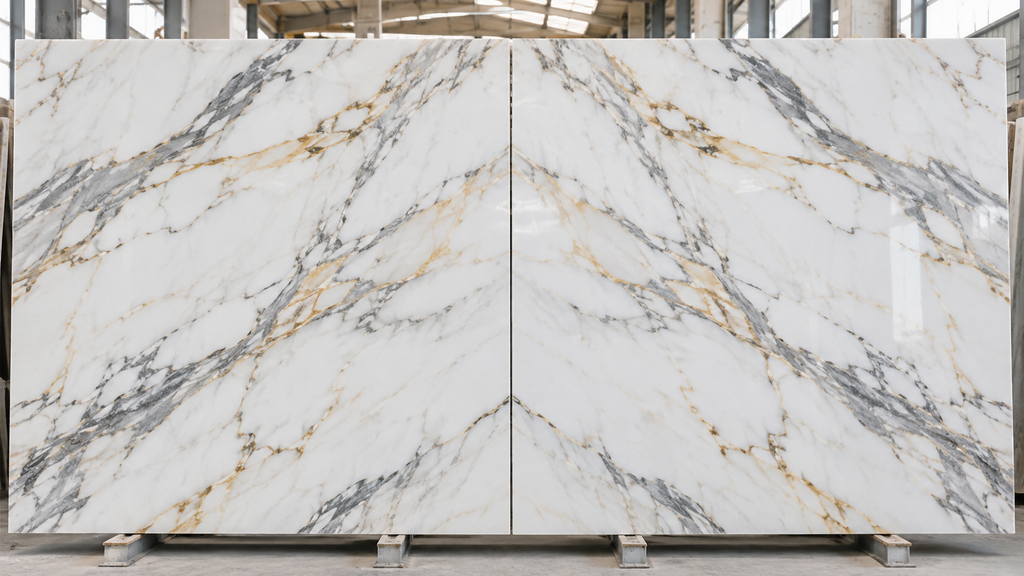
Veining is what you see first, so it is where buyers often judge too quickly. A strong vein is not automatically a good one. Look for veins that flow across the slab and continue naturally into the next, because that continuity is what makes book-matched walls and floors look intentional. Veins that stop abruptly, or sit in clusters of grey cloud, usually signal a lower grade.
Colour consistency matters just as much. Check slabs under daylight and under the lighting the room will use. White marble should read as a clean white or warm ivory, not a patchy mix of yellow and grey. Inspect the full lot, not one hand-picked sample, since shade drift between slabs shows up badly on large surfaces.
This is also how the best imported marble designs earn the name. A luxury imported marble collection is graded and sorted slab by slab, so what you approve is what ships. Ungraded stock sold at the same name often hides wide differences in tone and pattern.
3. Density, Porosity and Structural Soundness
Beauty fades quickly on a weak stone. Dense marble with low water absorption resists stains, takes a deeper polish and survives heavy foot traffic. Porous marble drinks up spills, oils and cleaning chemicals. Standards such as ASTM C503 set limits for marble, including a maximum water absorption of 0.20 percent, and a reputable supplier can share test results against them.
Structural soundness shows up in hairline fractures, which often run along the veins. Tilt the slab in raking light and run a hand across the surface. A tap with a metal key on a sound slab rings clean, while a dull or buzzing note can point to an internal crack.
Pay particular attention to large-format slabs, thin sections and countertop cut-outs. These stress the stone most, and a fracture that was invisible on a polished face can open during cutting or installation.
Request the test report for the lot you are buying. A report that covers absorption, density and flexural strength tells you more than any sales pitch.
4. Cutting, Calibration and Finishing
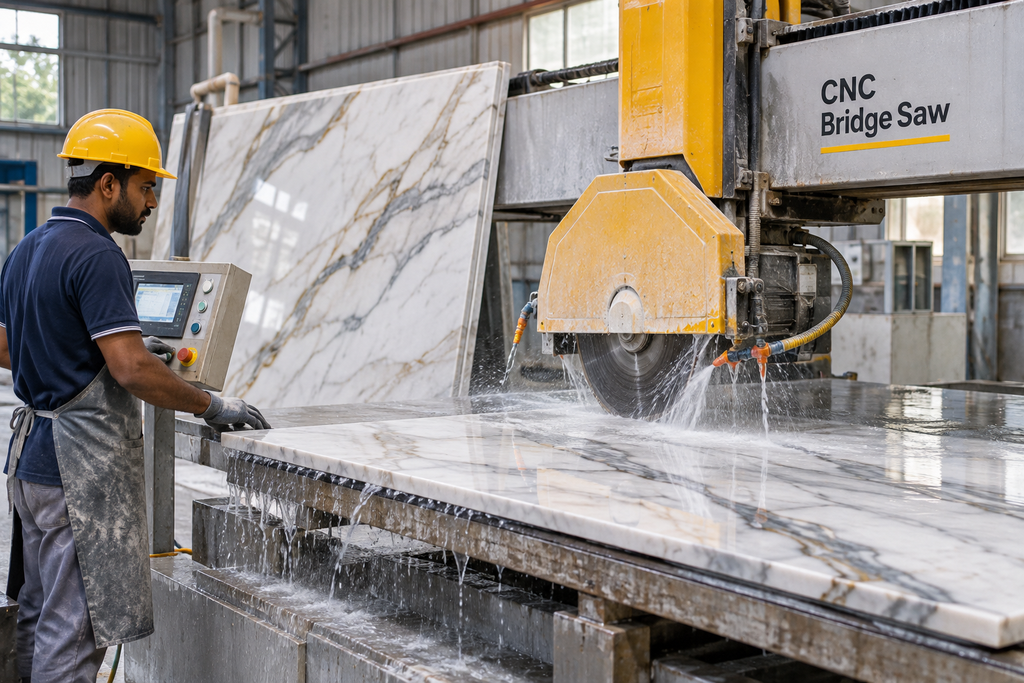
A flawless block can still be ruined on the factory floor. Precision cutting keeps thickness even across a lot, usually 18 to 20 mm for flooring, so tiles sit flat without lippage at the joints. Calibration and edge squaring decide whether a hundred tiles lay like one continuous surface.
Finish changes both looks and behaviour. A mirror polish gives deep gloss and shows veining at its best, but it also shows scratches and can be slippery in wet areas. A honed finish is matte, hides wear and suits bathrooms and outdoor-facing floors. Look at the finish under angled light, where swirl marks, pits, and uneven sheen become visible.
Surface treatment finishes the job. Quality suppliers apply an impregnating sealer that soaks into the stone instead of sitting on top. Resin filling on natural fissures is common and acceptable when disclosed, but heavy resin mesh on a cheap slab can hide weakness.
5. Dealers, Pricing and Documentation
The dealer is part of the quality chain. Among imported marble dealers in India, the reliable ones import directly, hold stock in their own yard, and let you inspect full slabs before you commit. Traders who source through several middlemen cannot trace a slab back to its block, and that gap is where mislabelled stone slips in.
Price should be read the same way. Imported marble price in India depends on the variety, grade, thickness, finish, and import costs, so two quotes for “Calacatta” can differ by a wide margin. A price far below the market is rarely a bargain. Ask what grade is quoted, whether the rate covers sealing and cutting, and how wastage is handled.
Before you pay, collect the paperwork: origin and lot details, test reports, and written confirmation of grade and finish. Then inspect the delivery against the approved slabs
Conclusion
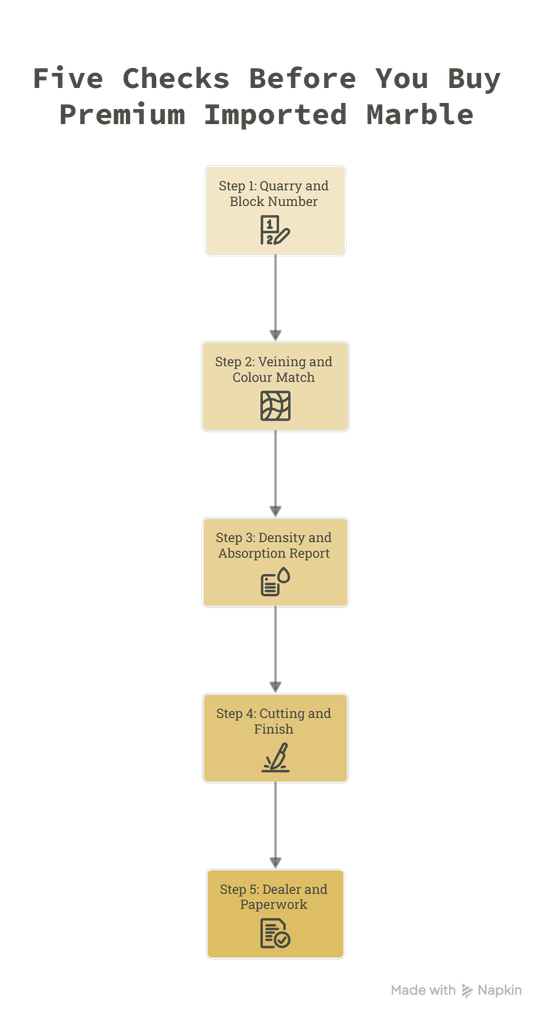
Premium imported marble in India is judged on five things: where the block came from, how the veining and colour hold across the lot, how dense and sound the stone is, how well it was cut and finished, and how transparent the dealer is. Check all five, and the price starts to make sense. Ready to see premium imported marble that passes every check above? Explore the Imported Marble collection at RRM Marbles and share your project brief to get a slab selection and quote.
FAQ
How can I tell if marble is genuinely imported? Ask for origin documents, the quarry name, and the lot number. A genuine importer can trace each slab to its block and shipment.
Is Italian marble always better than Spanish or Turkish marble? No. Each origin has strong varieties. Quality depends on the individual block, its grade and testing, not the country name alone.
What does water absorption tell me? It shows how much liquid the stone takes in. Lower absorption means better stain resistance and longer-lasting polish.
Is resin filling a sign of poor marble? Not always. Light filling of natural fissures is standard practice when disclosed. Heavy resin mesh used to hold a weak slab together is the concern.
Should I choose a polished or honed finish? Polished suits living areas where you want gloss and strong veining. Honed works better in bathrooms and spaces where slip resistance and low visible wear matter.
Why do two quotes for the same marble differ so much? Grade, thickness, finish, treatment and import costs all change the price. Compare quotes on the same specification before comparing totals.
Can I inspect slabs before buying? Yes, and you should. Reputable dealers let you view full slabs in daylight and approve the exact pieces for your project.
How do I keep imported marble looking new? Seal it on schedule, wipe spills quickly and use pH-neutral cleaners. Avoid acidic products such as vinegar or lemon-based cleaners.