
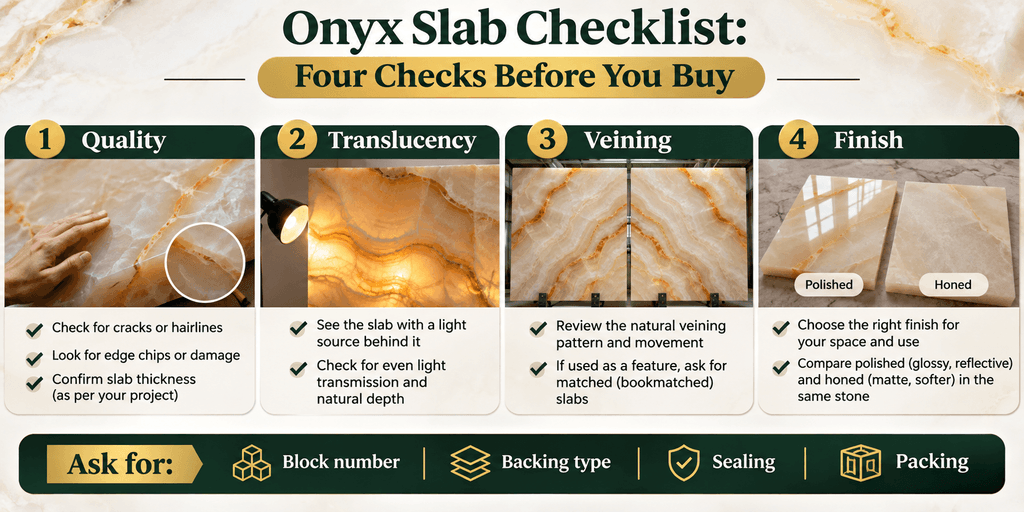
Two onyx slabs can look identical in a catalogue photo and behave nothing alike on a wall. One glows evenly under LED backlighting, holds its polish and arrives intact. The other shows dark patches, hairline cracks or a dull surface within the first year. The difference comes down to four things you can check before you pay: slab quality, translucency, veining and finish.
This guide takes you through those checks in the order a stone buyer would run them. It is written for homeowners, architects and designers who are shortlisting an Onyx Marble Supplier India projects can rely on, and who want to judge the slab in front of them instead of trusting a sales photo.
Start With What Makes an Imported Onyx Slab Worth Buying
Onyx forms from mineral deposits, mostly calcite, laid down in thin layers by water over a very long time. That origin explains both its beauty and its weakness. It is softer than most marble, so it scratches and chips more easily, and natural fissures run through many blocks.
When you compare imported onyx marble slabs, quality shows up in three ways. The block should be sound, with few open cracks, no crumbling edges and no large dull zones. Any repaired fissures should be filled neatly with resin that blends into the surrounding colour. And the slab should be flat and evenly cut, with the same thickness along its full length.
Onyx comes from several countries, including Iran, Pakistan, Mexico and Turkey, and origin tells you less than condition does. Ask for the quarry name, the block number and photographs of the exact slab you will receive, not a sample from the same lot.
Test Translucency Before You Commit
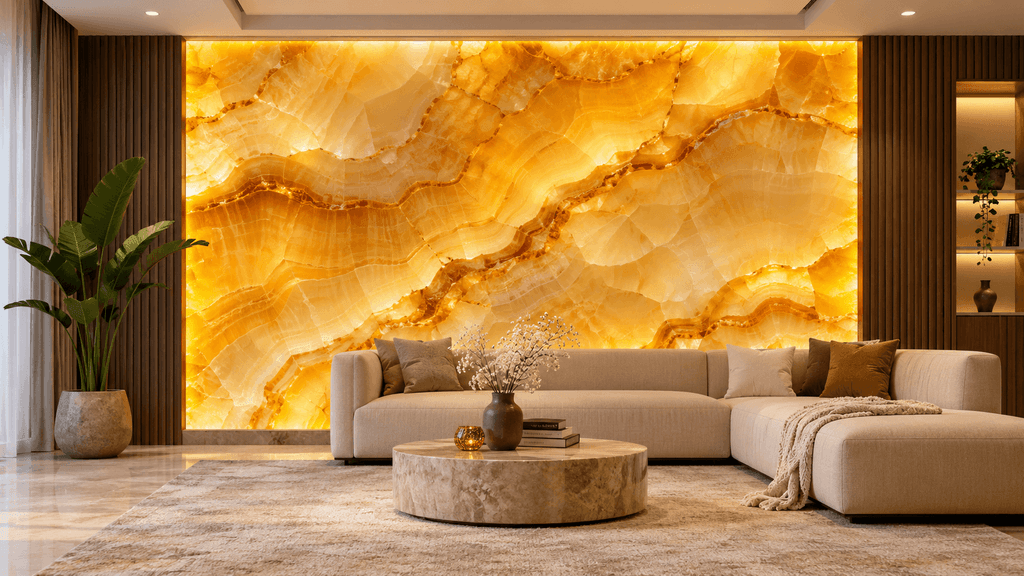
Translucency is the main reason people choose onyx, so test it with a strong light, not a catalogue photo. Ask to see the slab on a light table, or with a lamp held behind it.
Good onyx lets light spread evenly across the slab. Thin, pale areas pass light easily, while dense, dark or clouded areas block it. Some contrast is natural and often beautiful, but a large opaque patch in the middle of a backlit panel will look like a flaw once the LEDs are on.
If you are buying onyx marble slabs in India for a backlit wall, bar front or vanity, ask to see the slab lit from behind at the brightness you plan to use. Backlighting also exposes hairline cracks, resin repairs and thickness changes that stay hidden under normal showroom lighting.
The final glow also depends on the build. Onyx is usually reinforced with fiberglass backing, and that layer, together with the LED panel type and its spacing, changes how bright and even the wall looks. Agree the panel details before the slabs are cut.
Read the Veining and Colour, Not Just the Shade
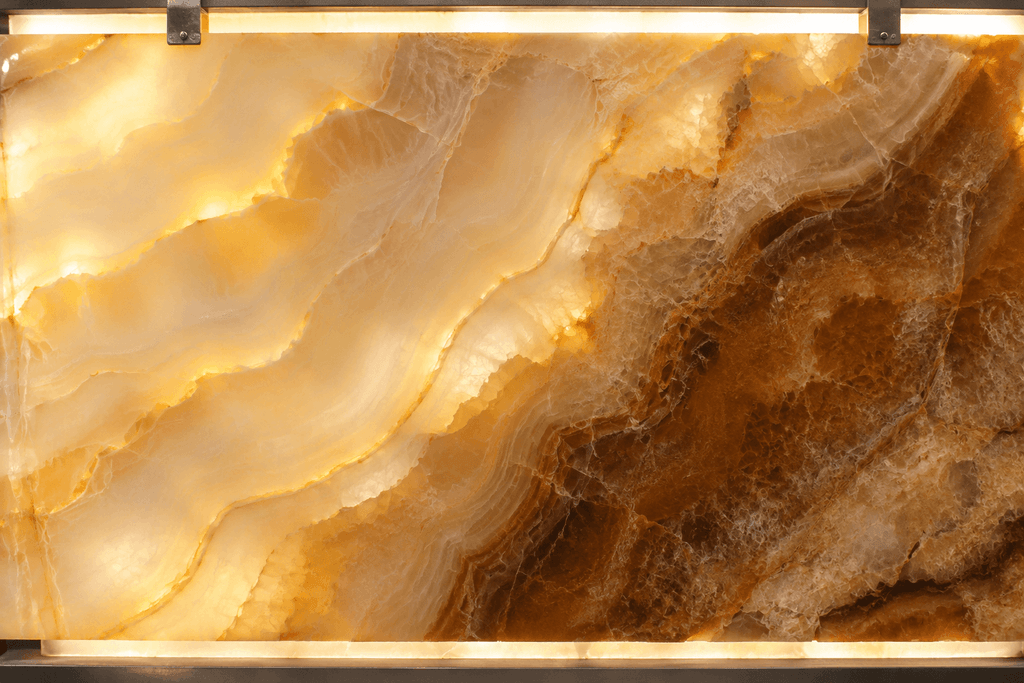
Onyx runs from icy white and honey amber to jade green and deep rose, and the banding inside each colour is what separates a plain slab from a striking one. Judge three things.
Direction and flow: bands that run in a clear line suit a wall or bar front, where the eye reads the pattern across a large surface. Swirled or cloudy patterns suit smaller pieces such as vanity tops and tabletops.
Contrast: strong dark veins make a statement but need careful placement. Soft veining is easier to live with in a bedroom or bathroom.
Consistency between slabs: if a project needs several pieces, ask for book-matched slabs cut from one block, or at least slabs numbered in sequence. A premium onyx stone collection should let you see a full run laid side by side, so you can check that the pattern carries across joints. Slabs from different blocks can differ a lot in shade even when they share a trade name.
View slabs under lighting close to what the installed space will have. Warm light turns white onyx creamy, and cool light flattens amber.
Check the Finish and Surface Treatment
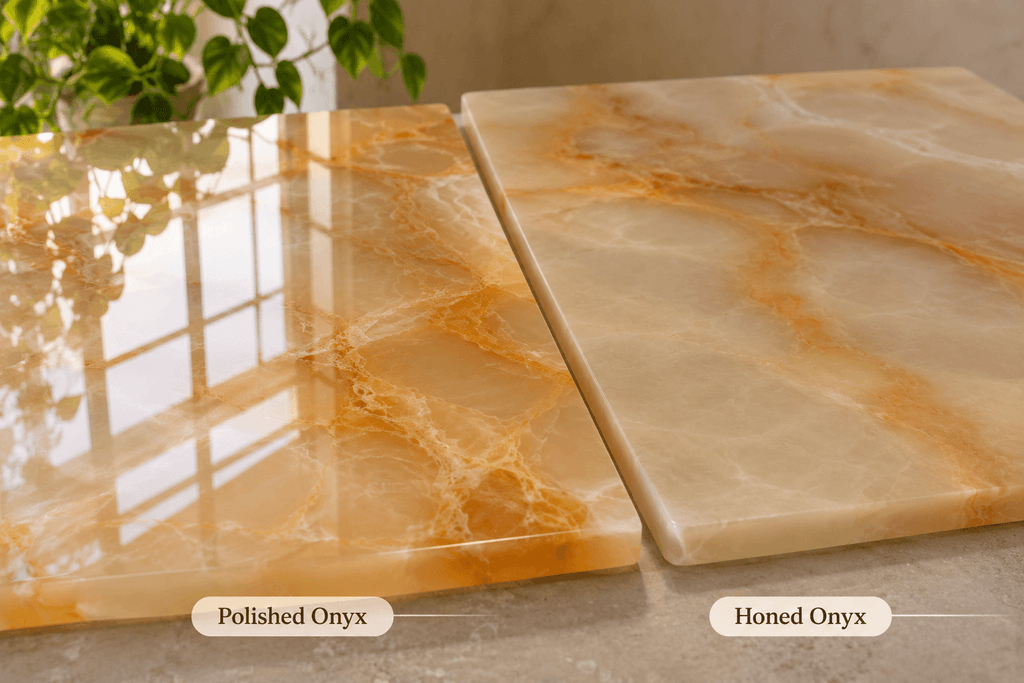
Finish decides how onyx looks and how long it lasts. Polished onyx gives the deepest colour and strongest glow, but it shows scratches and etching quickly. A honed finish is softer and more forgiving, though it mutes the colour a little.
For onyx stone for interiors, match the finish to the use. Polished suits feature walls, ceilings and decorative panels that nobody touches. Honed suits vanity tops, bar counters and tables, where hands, glasses and cleaning products come into contact.
Inspect the surface at a low angle against the light. Look for even reflection, with no waviness, swirl marks or pits. Run a finger along the edges and joins to feel for chips, then ask about sealing. Onyx is porous and sensitive to acids, so a good supplier seals the stone and explains care plainly: wipe spills fast, use a neutral cleaner, and keep citrus, wine and harsh chemicals away.
Onyx Marble Supplier India: Final Checks and Questions to Ask
Use up and down arrow keys to resize the meta box pane.
Before you approve a slab, run a short inspection and put your questions to the supplier in writing.
Walk the slab edge to edge in good light and photograph both faces. Check for open cracks, resin repairs, chipped corners and uneven thickness. Ask whether the slab is backed with mesh or fiberglass, and whether that happens before or after cutting. Get the dimensions, thickness and block number on paper, and confirm how the slabs will be packed and moved, since onyx breaks in transit more easily than harder stone.
Then ask about everything after purchase: who cuts the slabs, who installs them and who fits the LED panel. A reliable Onyx Marble Supplier India buyers can depend on should handle fabrication, backing, sealing and on-site assembly. RRM Marble describes this end-to-end service, from quarry selection to installation, on its onyx collection page.
Conclusion
Buy onyx the way you would buy a piece of furniture you plan to keep: look at the actual piece in the light it will live in. Check that the slab is sound, test the glow with a lamp behind it, compare the veining across every piece and choose a finish that suits how the surface will be used.
If you are comparing imported onyx for a feature wall, vanity or bar, start with RRM Marble’s onyx collection. RRM Marble is an Onyx Marble Supplier India projects can approach directly, and its design consultants say they will curate a slab selection for your brief within 48 hours. Send your dimensions and lighting plan through the enquiry form.
FAQ
What is onyx marble?
It is a translucent natural stone formed from layered mineral deposits, prized for its banded patterns and its ability to glow when lit from behind.
How do I know if an onyx slab is good quality?
Look for few open cracks, neat resin repairs, even thickness and a smooth surface. Ask for the block number and photos of the exact slab.
Is onyx suitable for floors and kitchen counters?
Rarely. It is soft and sensitive to acids, so it suits walls, vanities, bar fronts and decorative surfaces better than busy floors or working counters.
Why is onyx backed with fiberglass?
The backing reinforces thin, brittle slabs and holds fissures together, which makes cutting, handling and installation safer.
Can any onyx slab be backlit?
Most onyx transmits some light, but pale, thinner areas glow best. Test the specific slab with a lamp behind it before you choose.
Should I choose polished or honed onyx?
Choose polished for walls and decor, where colour depth matters. Choose honed for vanities and counters that people touch.
How do I care for onyx?
Seal it, wipe spills quickly, use a neutral cleaner and keep acids and abrasives away.
How do I choose an Onyx Marble Supplier India projects can trust?
View the actual slabs, get specifications in writing, and pick a supplier that handles cutting, backing, sealing and installation.